
If you enjoy watching anime, reading manga, or interacting with Japanese people, you’ve probably heard words like “San,” “Kun,” “Chan,” and “Sama” attached to the end of people’s names.
These are called Japanese honorifics (Keigo后缀). In Japan, using the right honorific is a crucial part of etiquette. Using the wrong one can lead to awkward misunderstandings!
In this easy guide, we will break down the exact meanings of San, Kun, Chan, and Sama, and show you exactly when to use them.
The Quick Summary Table
A quick summary table of the meanings and common uses of the Japanese honorifics San, Kun, Chan, and Sama.
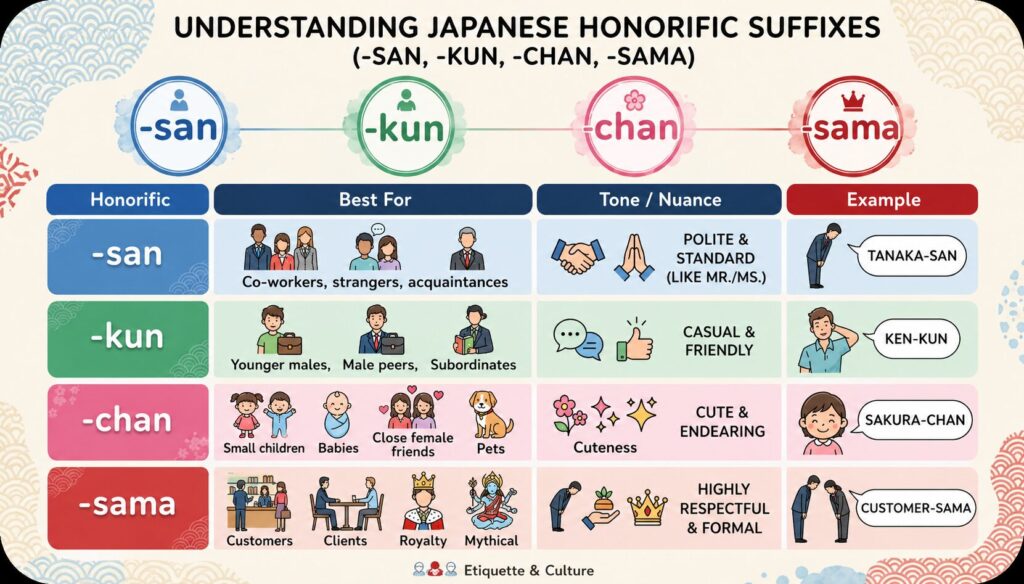
| Honorific | Best For | Tone / Nuance | Example |
| -san(さん) | Anyone (Co-workers, strangers, acquaintances) | Polite & Standard (Like Mr./Ms.) | Tanaka-san |
| -kun(くん/君) | Younger males, male peers, or male sub-ordinates | Casual & Friendly | Ken-kun |
| -chan(ちゃん) | Babies, young children, close female friends, pets | Cute & Endearing | Sakura-chan |
| -sama(さま/様) | Customers, clients, royalty, deities | Highly Respectful & Formal | Customer-sama |
1. What Does “San” Mean in Japanese? (The Safe Choice)
“-san” (さん) is the most common and versatile honorific in Japan. It is the English equivalent of “Mr.,” “Ms.,” or “Mrs.”
- When to use it: Use it with co-workers, acquaintances, or anyone you don’t know very well. It works perfectly for both men and women.
- Pro-Tip: When in doubt, always use -san. It is completely safe and polite!
- Example: If your colleague’s last name is Tanaka, call them Tanaka-san.
2. What Does “Chan” Mean in Japanese? (The Cute Choice)
“-chan” (ちゃん) is a diminutive suffix used for things that are cute, small, or dear to you.
- When to use it:
- Babies and young children (both boys and girls).
- Close female friends or family members.
- Pets (e.g., Pochi-chan).
- Golden Rule: Never use this in a business setting or with someone older/higher status than you, as it can sound childish or overly familiar.
3. What Does “Kun” Mean in Japanese? (The Casual Choice)
“-kun” (くん / 君) is mostly used for males, but it carries a slightly casual, peer-to-peer or top-down nuance.
- When to use it:
- Young boys or male teenagers.
- Male friends or classmates of a similar age.
- A boss addressing a subordinate (in this specific case, a boss might use -kun for both male and female employees).
- Note: Avoid using it for your boss or elders, as it implies you are looking “down” or on equal footing with them.
4. What Does “Sama” Mean in Japanese? (The Ultimate Respect)
“-sama” (さま / 様) is the ultra-respectful version of -san. It shows deep reverence and gratitude.
- When to use it:
- Customers or Clients (Crucial in Japanese business culture, e.g., Okyaku-sama).
- Royalty, deities (e.g., Kami-sama / God), or people you deeply admire.
- Fun Fact: You will often hear this in anime when characters address a lord, a princess, or a highly respected master.
The #1 Mistake to Avoid: Don’t Use It on Yourself!
Here is the most important rule of Japanese honorifics: Never use an honorific when introducing yourself.
Honorifics are meant to show respect to others. Saying “Hi, I am John-san” or “I am Emily-chan” sounds very strange and arrogant in Japanese. Always just say your name plain: “Hi, I am John.”
Conclusion
Understanding Japanese honorifics like San, Kun, Chan, and Sama is a fantastic way to appreciate Japanese culture and connect with native speakers.
- Want to be safe and polite? Stick with -san.
- Talking to a child or a close friend? Use -chan or -kun.
- Serving a customer? Show respect with -sama.